
On Friday, 6 November, Reynald Ponté defended his doctoral thesis at the Estonian University of Life Sciences, entitled “MnO₂ Nanomaterials for High-Performance Anode for Supercapacitors Applications”. His research explored how modifying the structure of manganese oxide could improve the performance and durability of energy storage devices.
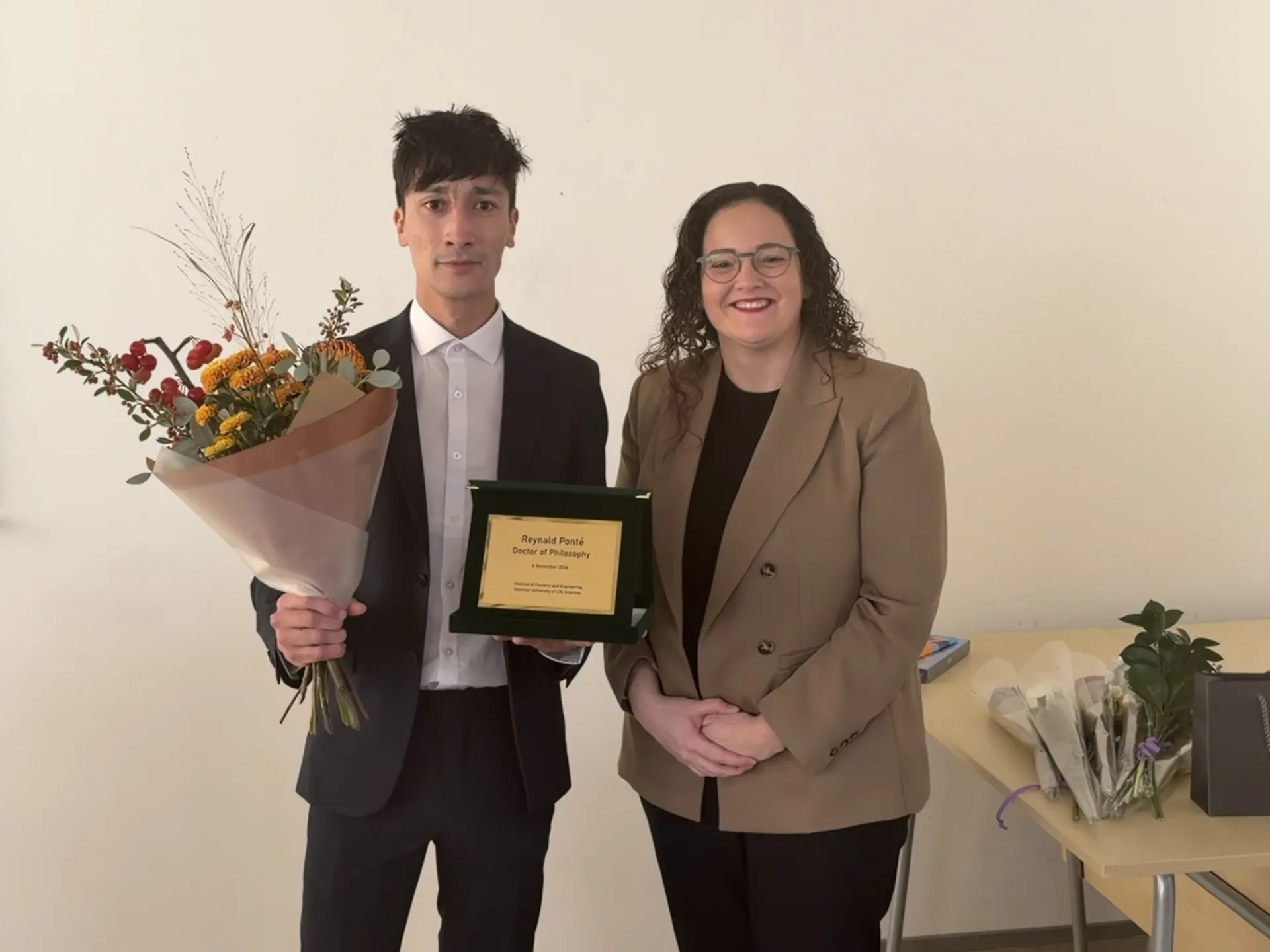
The doctoral thesis was supervised by Professor Lisandra Marina da Rocha Meneses, Dr Durga Parajuli (National Institute of Advanced Industrial Science and Technology, AIST, Japan), and Dr Larysa Khomenkova (National University of Kyiv-Mohyla Academy, Ukraine). The opponents were Dr Kremena Makasheva (CNRS, France) and Dr Tanel Käämbre from the University of Tartu.
The increasing use of renewable energy is driving the need for efficient, affordable, and environmentally friendly energy storage solutions. Batteries and supercapacitors often rely on expensive materials or materials with limited availability. Manganese oxide (MnO₂) is a promising alternative because it is abundant in nature, inexpensive, and has low toxicity. However, its practical application has been limited by poor electrical conductivity and relatively low energy storage capacity.
The structure of manganese oxide affects energy storage efficiency
In his doctoral research, Reynald Ponté investigated whether the energy storage capacity of manganese oxide could be improved without adding other materials, simply by modifying its synthesis conditions and internal structure. To achieve this, he prepared two forms of manganese oxide with different crystal structures and analysed their properties before and after heat treatment.
The study demonstrated that the internal structure of manganese oxide significantly affects both its energy storage capacity and durability. α-MnO₂, which has wider internal channels, achieved the highest capacitance because ions could move more easily through its structure. However, repeated charging and discharging caused structural changes that reduced the material's stability.
More durable materials pave the way for sustainable energy storage
In contrast, ε-MnO₂, which has a more compact structure, stored slightly less energy but proved considerably more durable, retaining more than 90% of its initial performance after numerous charge–discharge cycles.
The findings show that carefully tailoring the structure of manganese oxide can improve the performance of energy storage devices without the need for expensive additional materials. The research contributes to the development of simpler, more efficient, and more sustainable supercapacitors, which could support the wider adoption of renewable energy in the future.
The doctoral thesis is available in the digital archive of the Estonian University of Life Sciences EMÜ DSpacelink opens in new page.
Editor

Research Communication Specialist
Rector's Area of Responsibility
Department of Marketing and Communication
53585680
53585680