
On Monday, October 26th, Salini Chandrasekharan Nair defended her doctoral thesis at the Estonian University of Life Sciences, entitled “Production of algal exopolysaccharides via integration of thermal and biochemical processes”.
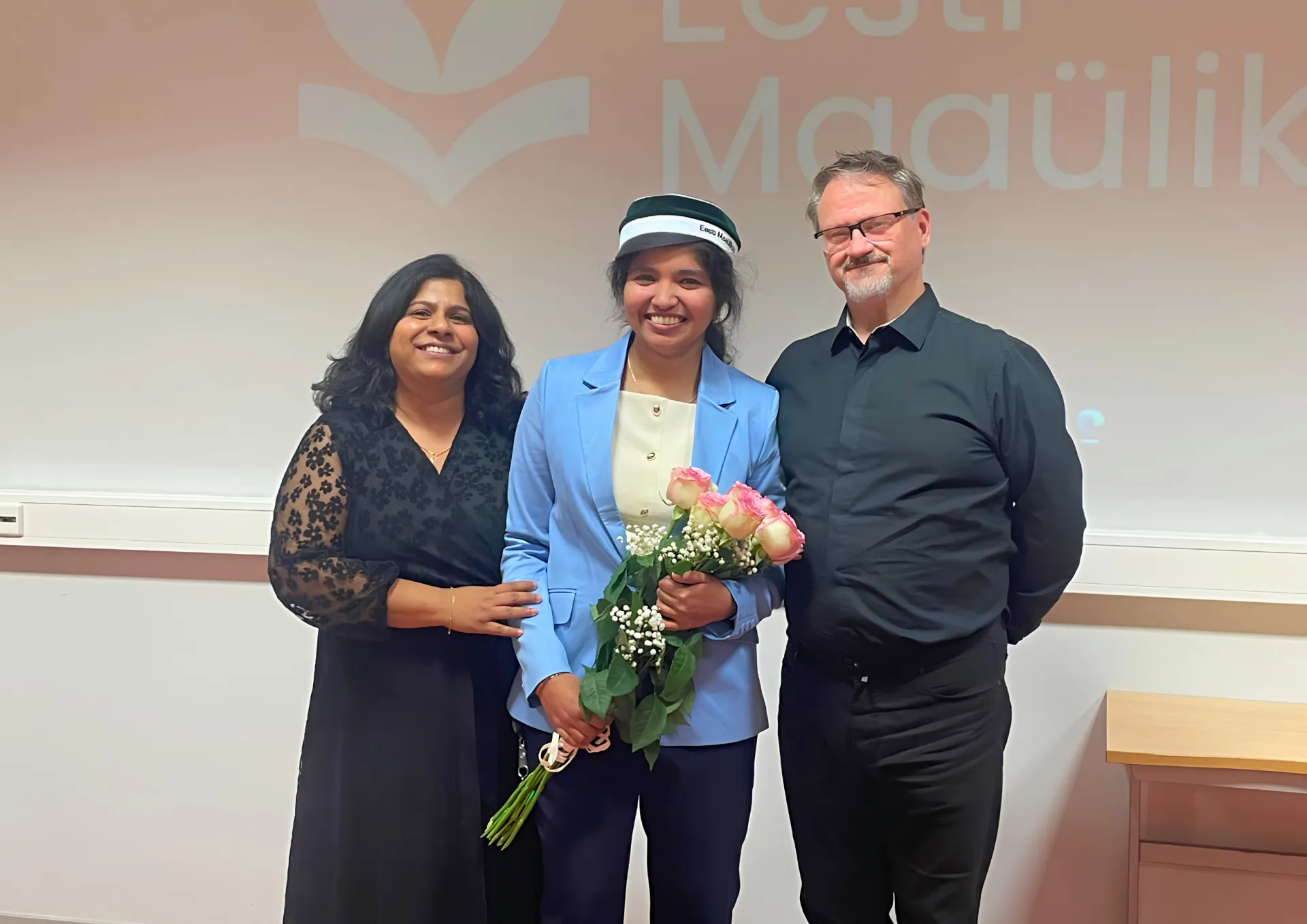
The doctoral thesis was supervised by Professor Timo Kikas and Associate Professor Renu Geetha Bai. The opponents were Professor Xinmin Zhan from the University of Galway, Ireland, and Professor Kalle Olli from the Estonian University of Life Sciences.
In the global search for sustainable alternatives to fossil resources, biomass has become an important renewable raw material for the production of energy and bio-based products. One method of biomass processing is torrefaction, a thermal treatment process that improves the fuel properties of biomass. However, this process also generates a liquid by-product known as torrefaction condensate, which is acidic and has a complex chemical composition. It is therefore generally considered a low-value waste stream.
In her doctoral research, Chandrasekharan Nair investigated whether this by-product could be used to produce valuable new products rather than being treated as waste. To explore this possibility, she cultivated two microalgae species, Chlamydomonas reinhardtii and Porphyridium marinum, in a growth medium containing torrefaction condensate.
Microalgae help turn by-products into valuable resources
The study showed that microalgae tolerated torrefaction condensate well at appropriate concentrations and that it could even stimulate the production of exopolysaccharides. Exopolysaccharides are natural biopolymers produced by microalgae. They have potential applications in the food industry, cosmetics, pharmaceuticals, biotechnology and environmental remediation.
Some compounds present in torrefaction condensate acted as mild stressors for the microalgae, triggering cellular defence mechanisms and increasing the secretion of valuable extracellular polymers. This suggests that a previously low-value by-product could instead serve as a beneficial growth supplement in microalgae cultivation.
A by-product from one process becomes a raw material for another
The doctoral research demonstrates the potential to integrate thermal biomass processing with microalgae cultivation into a circular system, in which by-products from one process are used as raw materials for another. This approach enables more efficient resource use, reduces waste generation and allows higher-value end products to be obtained from biomass processing.
Chandrasekharan Nair's findings contribute to the development of innovative bioeconomy solutions by demonstrating how low-value by-product streams from renewable energy production can be converted into high-value bio-based products. This approach supports the principles of the circular economy and offers opportunities for producing environmentally friendly biomaterials from renewable resources.
The doctoral thesis is available in the digital archive of the Estonian University of Life Sciences, EMÜ DSpacelink opens in new page.
Editor:

Research Communication Specialist
Rector's Area of Responsibility
Department of Marketing and Communication
53585680
53585680More information:

Junior Research Fellow of Engineering Sciences
Institute of Forestry and Engineering
Chair of Biosystems Engineering
