
"Kaugseire Eestis 2024: artiklikogumik"link opens in new page
Autorid: Tartu Ülikooli Tartu Observatoorium

Photo author: Karin Pai
Metsanduslik statistika R ja MS Excel keskkonnaslink opens in new page
Authors: Allan Sims, Andres Kiviste, Diana Laarmann
GNSS - globaalne satelliitnavigatsioonisüsteem geodeetilise täpsusega asukohamääranguks : õpik kõrgkoolidele
Authors: Artu Ellmann, Tarmo Kall, Karin Kollo, Aive Liibusk


Kaugseire Eestis 2021 artiklikogumik
Editor: Urmas Peterson.
This publication was made possible with the support of the University of Tartu, the Estonian University of Life Sciences, and the Estonian Environment Agency.
The article collection Remote Sensing in Estonia is a series aimed at providing an overview of environmental remote sensing research directions and the applications of research findings in Estonia.

Soils and Landscape Restorationlink opens in new page
link opens in new pageEditors: John A. Stanturf; Mac A. Callaham, Jr.
Soils and Landscape Restoration provides a multidisciplinary synthesis on the sustainable management and restoration of soils in various landscapes. The book presents applicable knowledge of above- and below-ground interactions and biome specific realizations along with in-depth investigations of particular soil degradation pathways. It focuses on severely degraded soils (e.g., eroded, salinized, mined) as well as the restoration of wetlands, grasslands and forests. The book addresses the need to bring together current perspectives on land degradation and restoration in soil science and restoration ecology to better incorporate soil-based information when restoration plans are formulated.

Metsa-aabits
Author: Juhani Püttsepp, NGO Mariekuld.
The publication of the book was supported by the Environmental Investment Centre (SA Keskkonnainvesteeringute Keskus).
With thanks to:
Vivika Kängsepp, Allar Padari, Andres Kiviste, Eha Järv, Kalevi Kull, Kalju Tarum, Külliki Kiviste, Paavo Kaimre, Tauri Arumäe, Veiko Uri, Estonian University of Life Sciences, Institute of Forestry and Rural Engineering at the Estonian University of Life Sciences, State Forest Management Centre (RMK).
The project was led by Eneli Põldveer and supported by Diana Laarmann, Teele Paluots, Ahto Kangur, and Henn Korjus.
Estonian University of Life Sciences and the Institute of Forestry and Rural Engineering at the Estonian University of Life Sciences, State Forest Management Centre (RMK)
Let’s go to the forest!
The word “forest” (mets in Estonian) is very old. If you could travel back in time five thousand years and meet one of our Estonian ancestors, they would understand what you mean when you say “mets.”
“Oh-oh-hoo! Mets!” the ancestor would roar with laughter and give you a friendly pat on the shoulder. “Birch, alder, bird cherry—oh-hoo!”
These days, we no longer say “toom” but “toomingas” (the full word for bird cherry tree). Over thousands of years and with the march of technology, many new forest-related words have appeared. Words like “drone” or “pellet” would likely make that ancestor scratch their head in confusion—but you probably understand them.
Researchers at the Estonian University of Life Sciences put their heads together and came up with a whole pile of forest-related words they believe children should know. Then, they divided these words into 32 smaller piles, based on the first letter of each word—32 being the number of letters in the Estonian alphabet. From these piles, I chose a selection of words to introduce to you with the help of forest alphabet stories.
That’s how our Forest Alphabet Book (Metsa-Aabits) was born.
A wise person once said that every book should include at least one story that you don’t understand at all—that’s how you learn. See if you can find such a story in this book!
Statistiline mets : 20 aastat statistilist metsainventeerimist Eestis
Authors: Viio Aitsam, Allan Sims, Tarmo Tolm, Maris Nikopensius, Helen Karu, Madis Raudsaar, Mati Valgepea, Tiiu Timmusk, Enn Pärt
Publisher: Keskkonnaagentuur
Achieving sustainable management of boreal and temperate forestslink opens in new page
Edited By John Stanturflink opens in new page
This collection reviews current research on balancing commercial use with the range of ecosystem services delivered by boreal and temperate forests.
Chapters survey advances in understanding forest ecophysiology, including mechanisms of root and canopy development and the way forest tress react to abiotic stress. The book also discusses current understanding of the ecosystem services that forests deliver and how they can be balanced with activities such as logging. Building on this foundation, it then reviews advances in sustainable forest management techniques, including improvements in breeding, monitoring forest health, innovations in planting, stand management and regeneration as well as harvesting/felling. The book also reviews ways of managing, insect and fungal pests as well as natural hazards. The final section of the book assesses sustainable ways of developing and diversifying forest products, including novel uses of timber, biomass, non-timber products and recreational services.
Kaugseire Eestis 2018 : artiklikogumik.link opens in new pagelink opens in new page
Editors: Urmas Peterson, Tiiu Lillemaa.
Publisher: Tartu Observatory, University of Tartu
Forest measurement with relascope : practical description for fieldwork with examples for Estonialink opens in new page
Author: Jüri Järvis
The following consultants have provided their contributions:
- Ahto Kangur
- Allan Sims
- Allar Padari
- Andres Kiviste
- Artur Nilson
- Mart Vaus
- Johannes Anniste
- Peep Põntson
- Priit Kohava
- Tiit Matson
The relascope and relascope measurement was invented and introduced by Austrian forest scientist Walter Bitterlich (Bitterlich 1947, 1948). The method is widely used because it is simple, handy and quick. However, the method is less accurate when compared to cross-callipering forest measurement. It is used for the preliminary assessment of timber supply in a tree stand 1. Simplified relascope is also called “simple relascope”, “angle-counter”, “angle-gauge” or “angle-template”. S ocalled true relascope or mirror-relascope is a device that can automatically adjust its measured values according to the slope of the ground (photo 1). Electronic relascope can be used instead of traditional mirror-relascope (e.g. Masser RC3, photo 2). Ground slope can be adjusted automatically by inserting slope angle value. Measurement result must be adjusted when using simplified relascope on slopes with angle exceeding 8°. Simplified relascope consists of a chain or non-stretching rope with precise length and rigid slab attached to it. The slab has one or more apertures with precise width (photo 3). It is also possible to create simplified relascope on one’s own, provided that aperture width and chain/ rope length have the greatest precision. Aperture width must remain within tolerance range of 0.1 mm and the length of the chain/rope within the range of 1 mm (Kohava 2002). Instead of a slab, a pen with round crosssection can also be used (photo 4).
Forest Relascope Measurement: Determining Stand Basal Area, Quality, and Volume Using a Simple Relascope
Author: Jüri Järvis
Consultants:
- Allan Sims, Estonian University of Life Sciences (EMÜ)
- Allar Padari, EMÜ
- Andres Kiviste, EMÜ
- Artur Nilson, EMÜ
- Johannes Anniste, OÜ Metsabüroo
- Mart Vaus, EMÜ
- Peep Põntson, OÜ Metsaekspert
- Priit Kohava, Environmental Information Centre
- Tiit Matson, OÜ Forinfo
Mining and rehabilitation in Estonia
Autor(s): Elmar Kaar, Külliki Kiviste
The book is intended for professionals involved in mineral extraction and land reclamation, but it is also suitable as study material for students and for all nature enthusiasts interested in Estonia’s present and future.
Summaries of the articles are available in English.
The content of the book can be ordered digitally from the department.

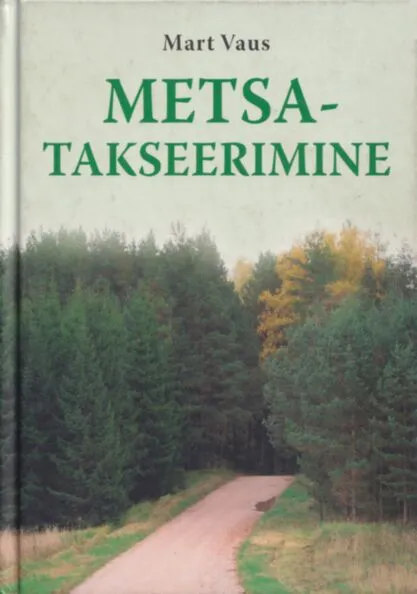
Forest Tending
Author: Mart Vaus
The need for a new book on forest tending arose because the only work on this topic in Estonian, T. Krigul’s Metsatakseerimist (1972), is difficult to obtain. Since then, several areas of forest tending have developed further and acquired somewhat different approaches.
The book is primarily intended for students of forestry, but it may also serve as a useful reference for employees of state institutions and private companies working in the forestry sector, as well as for private forest owners.
The content of the book can be ordered digitally from the department.
Metsa hindaminelink opens in new pagelink opens in new page
Authors: Jüri Jänes, Allar Padari
Consultants: Mart Vaus, Andres Kiviste, Henn Korjus, Mati Valgepea
The brochure was produced within the framework of the Finland–Estonia cooperation project "Improving Timber Measurement Practices in Estonia."
